

A sector-focused VC is a venture firm that puts most of its portfolio into one industry, such as healthcare, fintech, climate or defense. For founders, the practical result is simple: the firm already understands your market, your regulators and your buyers, but it will pass quickly if you sit outside its lane. The most efficient way to raise from specialists is to build a short list of firms whose focus matches your company and to reach them through a warm, tailored introduction. That is the work we do at KapVista, and the rest of this guide explains the logic behind it.
TL;DR
- A sector-focused (specialist) VC invests most of its portfolio in one industry. A generalist does not restrict itself by industry.
- "No investment focus" is one of the two most common reasons deals are rejected at screening, so mismatched pitches rarely get a second look.
- PitchBook's fund data shows specialists lead on TVPI, and smaller specialist funds do especially well, which explains why they move with conviction.
- Match your sector, stage and check size to a firm's stated thesis before you write a single email.
- A tailored introduction to the right specialist beats a mass send-out to fifty generalists.
Table of Contents
- What counts as a sector-focused VC
- What specialists actually back
- What the data says about specialist performance
- Why a specialist often moves differently
- Why the right match matters more than the best name
- How to find and approach the right sector-focused VC
- Should you target specialists, generalists or both?
- For investors, funds and family offices
- What we do at KapVista
- Our perspective
- FAQ
- Sources
What counts as a sector-focused VC
Academic work gives a clean definition. In a Wharton-affiliated study of venture firms, generalist firms are those that do not restrict the industries they invest in, while specialists invest most of their portfolio in one industry. The same study treats that orientation as long-term and hard to change. A firm that built its reputation in medical devices is not going to pivot to consumer apps because the market shifted.
Two more terms help. Limited partners (LPs) are the institutions and wealthy individuals who put money into a VC fund. TVPI (total value to paid-in capital) is the multiple of value a fund has returned, or still holds, against what LPs committed. VCs mostly invest that LP capital rather than their own: the NBER working paper on how venture capitalists make decisions describes VCs as institutional investors whose returns are measured against LP commitments. That matters to you because a specialist has to explain every bet to LPs who bought into a specific thesis.
What specialists actually back
Specialist does not mean small or narrow in ambition. It means the firm defines its edge by industry knowledge. Three examples show how differently that can look:
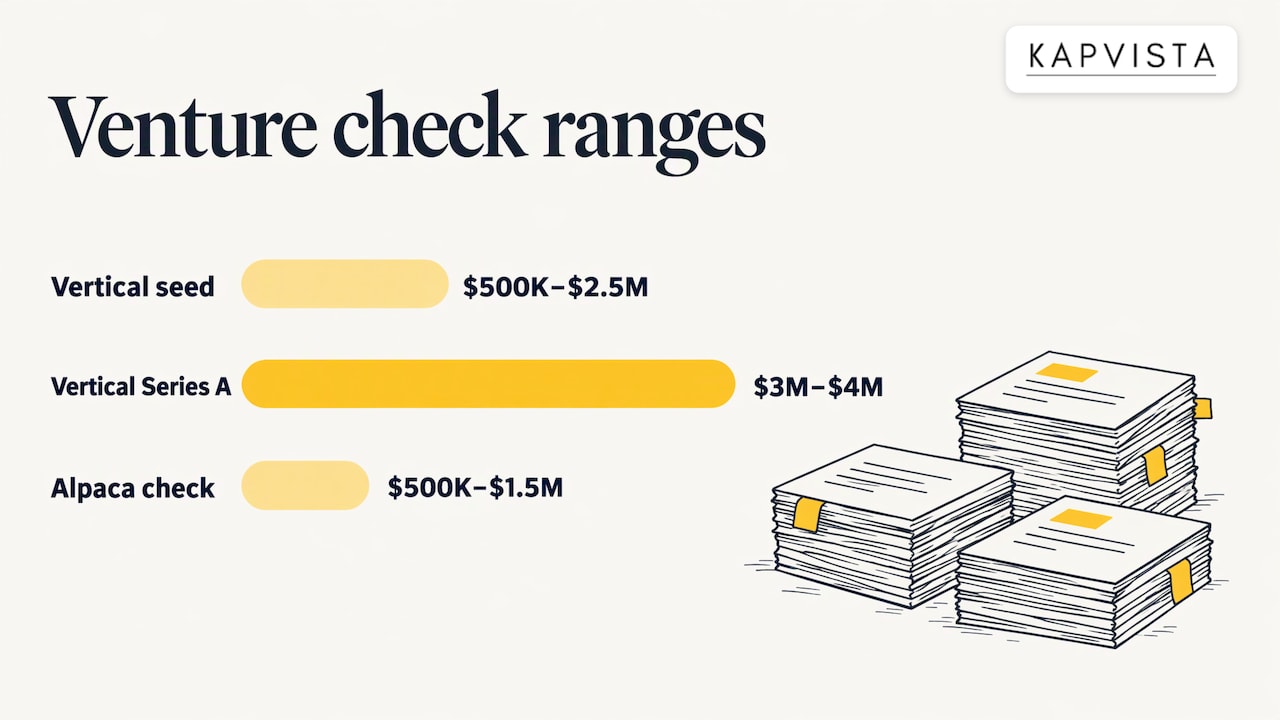
- Regulated industries. Vertical Venture Partners targets pre-seed through Series A in healthcare, financial services, education and logistics, with seed checks of $500K to $2.5M and Series A checks of $3M to $4M.
- University science. Parkwalk, a UK fund, backs university spinouts from Seed to Series C in DeepTech, HealthTech and CleanTech, working with university commercialization teams to reach founders and intellectual property early.
- Real-world systems plus AI. Alpaca writes pre-seed and seed checks of $500K to $1.5M, often leading or co-leading with a board or observer seat, into AI-native companies in manufacturing, logistics, energy, construction, defense and commerce infrastructure.
Notice what each firm publishes: a sector list, a stage and a check range. That trio is your first filter. If your company does not fit all three, the firm is not your target, however impressive its brand.
Specialization also varies by country. A study of 70 active Indian VC firms found that foreign high-tech investors managed information risk through domain specialization and deep sector knowledge, while domestic firms were generally less specialized, partly because of limited market depth. If you raise outside the US, expect the share of true specialists to differ by market.
What the data says about specialist performance
Founders often ask whether specialists are simply better investors. The evidence is nuanced, and the nuance is useful.
PitchBook analyzed 1,306 VC funds with vintages from 2000 to 2020. The overall performance gap between specialist and generalist funds was not significant, but specialists led on TVPI. Within the 2015 to 2020 cohort, specialists showed better IRR, and specialist funds under $250M were the clear winners on both IRR and TVPI. For funds above $250M, the most recent generalist cohort led by nearly 5 percentage points on IRR.
PitchBook's explanation is intuitive. Smaller specialist funds focus on earlier stages, where deep single-sector knowledge and a concentrated network help them identify promising startups and read market trends. Larger generalist funds gain from diversification, which smooths returns when one industry underperforms.
A peer-reviewed study in Financial Management reached a complementary conclusion: neither a pure-play specialist strategy nor a diversified generalist strategy optimizes both fund growth and time to exit. The lesson for founders is that specialists are built around a deliberate thesis. When your company sits squarely inside it, you are talking to an investor who has structured the whole fund around companies like yours.
Why a specialist often moves differently
Different industries reward different things. In a Journal of Financial Economics survey of 885 institutional VCs at 681 firms, the management team was important to 95% of firms and most important to 47%. Business model, product, market and industry were important to 83%, 74%, 68% and 31% respectively. But the same survey found variation by sector: 55% of the healthcare subsample picked business-related factors as most important, versus 32% who picked the team, consistent with intellectual property mattering more in health businesses.
In practice, that means:
- A healthcare or deep-tech specialist will push hard on IP, regulatory path and clinical or technical milestones.
- A software or consumer investor will weigh the team and traction more heavily.
- A specialist in a regulated vertical will often ask how you plan to handle compliance before they ask about growth.
Prepare for the questions that sector asks, and you signal that you understand your own market.
Why the right match matters more than the best name
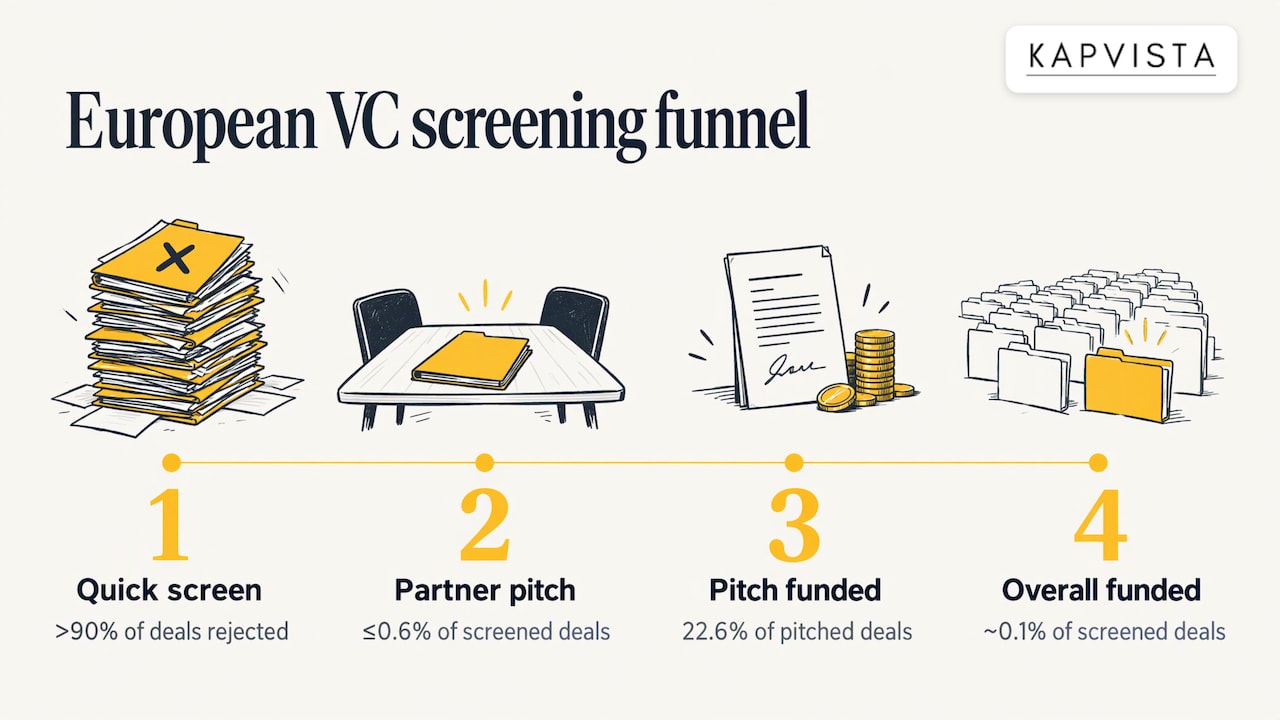
Venture screening is brutal. A University of St. Gallen study of 14,549 deals screened in Europe from 2017 to 2020 found that more than 90% were rejected in a quick screening pass. No more than 0.6% of all screened deals reached a partner-level onsite pitch, and 22.6% of pitched deals were funded, roughly a 0.1% chance relative to everything screened. The two most common rejection reasons were "no venture capital case" and "no investment focus." The authors advise founders to check each VC's industry and geographic focus before approaching.
That second reason is entirely within your control. You cannot always fix a market that is too small, but you can avoid sending a medical-device pitch to a fintech specialist.
The broader picture is similar elsewhere. A UK Department for Business and Trade survey of 1,200 early-stage companies found that 44.9% of ventures seeking equity finance secured none, with pre-trading businesses failing at 55.4%. Among the barriers named were being too early-stage, IP concerns, management capability and limited investor knowledge and fit. Investor fit is the one barrier you can work on this week.
How to find and approach the right sector-focused VC
Here is the routine we would follow, step by step, including where it tends to go wrong.
1. Define your sector precisely
"Healthtech" is too broad. Is it clinical software, diagnostics, a consumer wellness app or a reimbursement tool? Specialists draw their own boundaries sharply, and the wrong subcategory is a polite pass. Write one sentence naming your customer, your buyer and your regulatory exposure.
2. Build the list from published theses
Read each firm's investment page for the sector list, the stage and the check range, as in the examples above. Then read recent portfolio announcements to see what the firm really funds, not only what it says. Where this goes wrong: founders rely on a stale ranking, and the firm has since shifted focus. Our guide on building two lists and a pitch under 90 seconds walks through a fast way to do it.
3. Test the fit from both sides
Check whether the firm has a conflicting portfolio company, how involved it is after the check, and whether the partner has operated in your industry. Our write-up on founder-investor fit and the investor red flags guide give you questions for both directions.
4. Tailor the pitch to the thesis
Open with the sentence that proves you belong in their lane: the market size in their terms, the regulatory milestone, the technical proof point. Keep the deck factual and make the ask explicit with amount, stage and use of funds. Before you send anything, run through our capital raising checklist so the data room is ready when interest arrives.
5. Get introduced rather than cold-emailing
A cold email enters the same pile that the St. Gallen study describes. A relevant introduction changes how the first few minutes of screening go. If you want to approach firms directly, our guide to reaching VCs online covers the mechanics. If you want your profile in front of qualified investors without building every relationship from scratch, that is what the KapVista platform is for.
6. Prepare for diligence on the sector's terms
Expect sector-specific questions and a fast, detailed review. Our investor due diligence checklist lists what early-stage startups should have ready, and our piece on seed round valuation and terms shows what to check before you sign.
Should you target specialists, generalists or both?
A reasonable approach is to lead with specialists and add a few generalists as a second wave.
| Factor | Sector-focused VC | Generalist VC |
|---|---|---|
| Industry knowledge | Deep, usually operator-level | Broad, varies by partner |
| Network | Concentrated in one industry | Spread across industries |
| Typical stage in the data | Smaller funds skew earlier | Larger funds skew later |
| Rejection risk if you are off-thesis | High | Lower |
| Follow-on support | Sector introductions to buyers, talent and co-investors | Broad platform resources |
If you are pre-seed or seed, specialists are often the logical first conversation, because the PitchBook data links smaller specialist funds with earlier-stage investing. If your product crosses industries, a generalist may be a better opening and a specialist a strong co-investor.
For investors, funds and family offices
This topic cuts the other way too. If you are an angel or family office looking for opportunities, a specialist's thesis is a useful template: define the industries, stage and check size where you can add more than money, then screen against that. If you run a fund and want to connect with limited partners, your published thesis is your most important marketing asset, because LPs buy a specific strategy. The same clarity that helps founders get past screening helps funds get past LP due diligence.
What we do at KapVista
KapVista is a global platform that connects early-stage founders with VCs, family offices and angel investors. Our network includes more than 25,000 high-net-worth individuals across 15 countries, and we focus on tailored introductions and direct support from experienced advisors. Founders can start with a basic profile, and paid offerings start from $39 per month. We also offer Investor Relations as a Service in Basic, Standard and Premium packages, and an Investor Deal-Flow service for investors.
If you are ready to put your company in front of investors whose focus matches yours, see the plans and how a profile works, or explore the Investor Relations packages.

Our perspective
Most founders we talk to treat fundraising as a numbers game: send more emails, get more meetings. The evidence points the other way. When more than 90% of deals are rejected in a few minutes of screening and "no investment focus" is a leading reason, volume without fit is just a faster way to be ignored.
What we believe is that the founder's scarcest resource is attention from the right investor. A specialist who already understands your market can move quickly and bring the right introductions. A generalist can be a strong partner too. The skill is knowing which conversation to start first and why.
That is why we built KapVista around tailored introductions and support from experienced advisors rather than a directory. Our aim is simple: help you reach qualified investors across 15 countries with a pitch that speaks to what they actually fund, so the first meeting is about your company and not about whether you belong in the room.
Daniel
FAQ
Do VCs invest their own money?
Mostly no. Venture firms manage funds raised from limited partners, and their returns are measured against what those LPs committed. Individual partners may invest a small amount alongside the fund, but the capital you receive normally comes from the fund. That is why every check has to fit the fund's stated thesis.
Are sector-focused VCs better than generalist VCs?
Not across the board. PitchBook's analysis of 1,306 funds found no significant overall performance gap, though specialists led on TVPI and smaller specialist funds did especially well. For a founder, the better question is which investor understands your market and can open doors in it.
How hard is it to get venture capital at the early stage?
It is selective. The St. Gallen study found only about 0.1% of screened deals ended up funded, and the UK Department for Business and Trade found 44.9% of early-stage ventures seeking equity secured none. Targeting firms whose focus, stage and check size match your company improves your odds of getting past the first screen.
How do I know if a VC is truly sector-focused?
Read the firm's investment page for a named sector list, a stage and a check range, then compare it to recent portfolio announcements. A real specialist's portfolio clusters in one industry. If the portfolio is scattered, the firm is acting as a generalist whatever its tagline says.
Sources
- Alvarez-Garrido, Uncovering the Impact of Venture Capital Firms on Startup Innovation (Wharton)
- NBER working paper w22587, How Do Venture Capitalists Make Decisions?
- Vertical Venture Partners, How We Invest
- Parkwalk, Investment Strategy
- Alpaca, Our Approach
- Managing the risks from high-tech investments in India (Springer)
- PitchBook, Battle of the funds: Do VC specialists outperform generalists?
- Knill, Should Venture Capitalists Put All Their Eggs in One Basket? (Financial Management)
- Journal of Financial Economics survey of VC decisions
- University of St. Gallen, Looking Behind Closed Doors at Venture Capital Investments
- UK Department for Business and Trade, The Early-Stage Equity-Finance Journey of Potential High-Growth Companies in the UK