
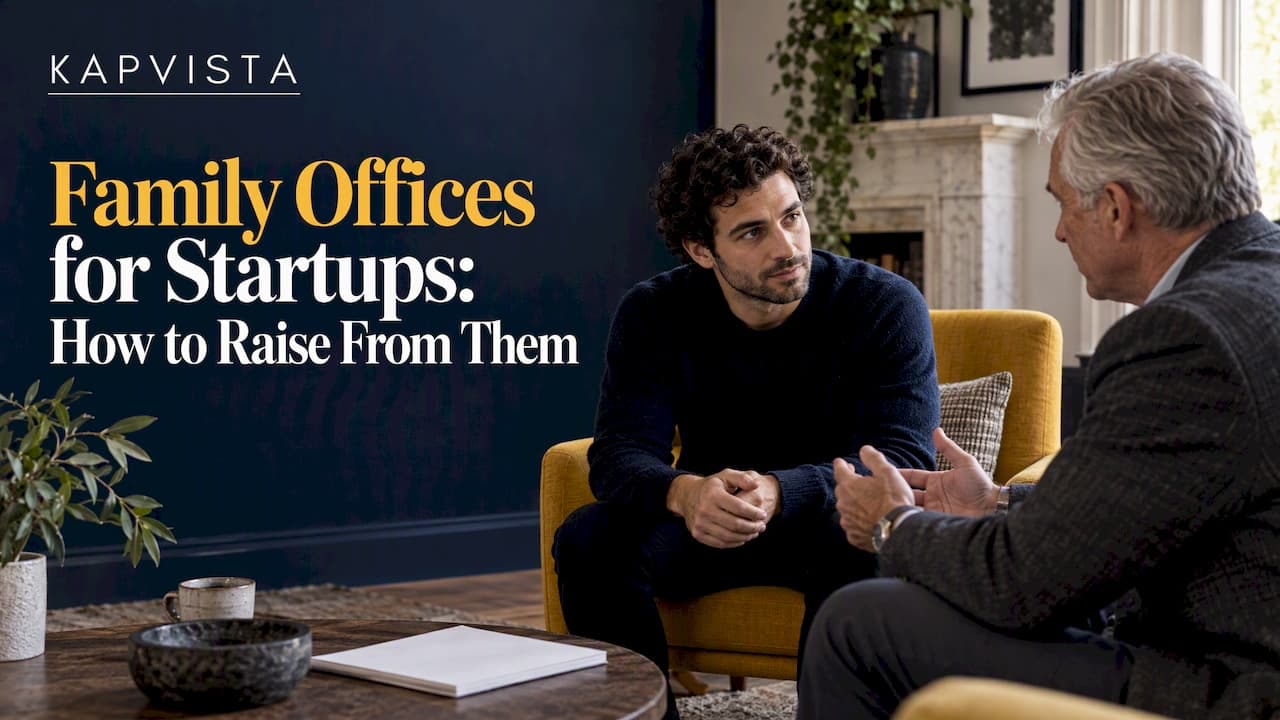
Family offices are private investment firms that manage a single family's wealth, and a growing number of them write checks into early-stage companies. For a founder, they can be a source of patient capital with fewer fund-driven deadlines, but they are not interchangeable with venture funds. They decide differently, move at their own pace and care about different things. This guide explains how they work, which ones to target, how to get in the room and what to prepare before you do.
TL;DR
- Family offices account for roughly 31% of startup capital deployed, and 83% of those deals are club deals, so expect to share a cap table with co-investors.
- They invest principal, not a fund with an exit clock, which usually means more patience and more flexibility than a VC.
- Warm introductions beat cold outreach. Research each office's sectors, structure and family story before you write.
- Expect personal diligence and slow follow-on decisions. Keep your legal structure clean from day one.
- Build a short list of 20 to 30 targets, not a spray of 300 emails.
Table of Contents
- What a family office is, and why founders should care
- How much capital is really on the table
- Family office versus venture fund: the real differences
- What family offices want to see in a startup
- How to find the right family offices
- How to approach them: introductions, outreach and follow-up
- Deal structures and diligence to expect
- Where a family office can fit in your round
- Where the family's own goals come in
- Our perspective: treat a family office as a relationship, not a lead
- How KapVista helps you reach family offices and other investors
- A founder's checklist before the first call
- FAQ
- Sources
What a family office is, and why founders should care
A family office is a private structure that gives one family dedicated coordination of its investments, tax, reporting and often philanthropy. NerdWallet's overview describes it as a private company that manages the wealth of a high-net-worth family, and adds that the work can extend to estate planning, insurance and real estate. Some of the best-known examples are very large, such as the family offices behind Walton Enterprises or Cascade Investment. But the category is much broader than the household names.
There are three shapes you will meet:
- Single-family offices serve one family. According to Zephyr's setup guide, a dedicated single-family office generally needs at least $100 million in investable assets, and running one averages $3.2 million a year.
- Multi-family offices serve several families. The same guide puts typical minimum net worth at $25 million to $50 million, with fees of 0.2% to 1.25% of assets under management.
- Virtual family offices coordinate external advisors for families with around $10 million, at annual costs of $100,000 to $300,000.
Why does this matter to you? Because the structure tells you what kind of check, and what kind of decision process, to expect. A single-family office with a principal who built a logistics company will react to a freight-tech deck very differently from a multi-family office that allocates through funds.
How much capital is really on the table
The headline number is large. BlackRock's family office report data points to family offices providing about 31% of total startup capital deployed, with alternatives making up around 42% of the average family office portfolio. The peak deal volume of 2021 has cooled, but the category is still a major allocator.
The way they deploy matters even more than the volume. A 2026 analysis of direct investing reports that about 70% of family offices make at least one direct private investment a year, and that 83% of those deals are co-investments or club deals rather than solo checks. In practice, that means your round is rarely won by one office alone. It is assembled from a few families, a lead investor and sometimes an angel syndicate.
A caveat on the numbers: these are survey-based estimates from large, mostly institutional-grade offices. The typical family office reading your email is smaller, more private and less likely to appear in any dataset.
Family office versus venture fund: the real differences
The most useful way to think about a family office is as an investor with a different mandate, not a smaller VC.
| Factor | Venture fund | Family office |
|---|---|---|
| Source of capital | Limited partners, with a fixed fund life | The family's own principal |
| Time pressure | Exit timeline driven by fund math | Often patient, sometimes multi-decade |
| Decision process | Investment committee, partner votes | One principal or a small circle, informal |
| Goals | Return multiples on a portfolio | Wealth preservation, legacy, sector fit, sometimes mission |
| Support | Platform team, follow-on reserves | Introductions to the family's network, operating advice |
| Speed | Structured, predictable | Can be fast on the first check, slow on follow-ons |
Practitioners at Dakota point to this fund math as the reason founders sometimes feel pressure from VC and PE funds that family offices simply do not apply. Because they invest principal, they can support a company without a looming fund liquidation.
The flip side is real, too. Spectup's investor guide notes that founders are often disappointed because they misread the office's mission: a family office may weigh preservation, legacy or sector synergy more than a pure growth return. Pitch the wrong story and you will hear polite interest and then silence.
What family offices want to see in a startup
Every office is different, but a few themes recur.
A fit with the family's world
Many families made their money in one industry: real estate, shipping, retail, manufacturing, healthcare. They understand that sector deeply and trust their own judgment in it. A startup that improves a business they know, or opens an adjacent market, has a head start over a generic pitch.
Durable themes over hype
The 2026 UBS Global Family Office Report points to a more defensive, resilient posture, with offices diversifying regionally and looking for structural themes such as infrastructure, private credit and energy transition. If your company sits inside one of those themes, say so plainly and show why the demand is durable rather than cyclical.
Alignment on time horizon
If you are building a business meant to compound over a decade, a family office can be a natural partner. If your plan depends on a quick flip to a strategic acquirer in three years, say that honestly. Misaligned expectations are the most common reason these relationships sour. One practitioner-reported pattern, from a thread on r/startups, is a family that expects a 2x return within five to ten years. That is a different target from a venture fund's, and you should ask about it directly.
Founders they can trust personally
With a family office, you are often underwriting a relationship with a person or a small family circle. Reliability in updates, candor about problems and a clear sense of how you treat people carry real weight, perhaps more than they do in a committee-driven fund.
How to find the right family offices
The common mistake is to treat the category as one big list. Start with a filter.
- Define your investor profile. Stage, check size, sector, geography and whether you want a lead, a co-investor or a strategic partner.
- Sort offices by how they invest. Direct investors, fund-of-funds allocators and co-investors behave differently. Ask early whether an office co-invests, leads or comes in through funds, so you can position your round accordingly.
- Research the family. Where did the wealth come from? Which sectors have they backed? Which causes do they fund? What did their last three deals look like?
- Build a list of 20 to 30. A tight list lets you personalize every message and track every conversation.
- Map your warm paths. For each target, find the common connection: an advisor, a lawyer, another founder they backed, a co-investor.
Public directories and databases can seed the list, but treat them as a starting point. Many offices deliberately keep a low profile, and a directory entry says little about whether an office is actively writing early-stage checks right now.
If you want a shortcut to qualified investors, including family offices, KapVista is a global platform that connects early-stage founders with VCs, family offices and angel investors. We describe it in more detail below, but the principle holds either way: your list should be built on fit, not size.
How to approach them: introductions, outreach and follow-up
Family offices guard their privacy. Elev-X's founder guide is blunt that warm introductions through advisors, other founders or co-investors work far better than cold outreach.
Get introduced
The strongest introductions come from someone the family already trusts: their attorney or accountant, a portfolio founder, a co-investor, or an advisor from their own sector. Ask the introducer for a two-line forwardable note, so they can send it in under a minute.
If you must write cold
Keep it short and specific.
- One sentence on who you are and what you have built.
- One sentence on why this particular family, referencing a past investment or stated interest.
- One concrete proof point: revenue, a pilot with a recognizable customer, a waitlist.
- A modest ask: a 20-minute call, not a check.
Attach nothing heavy. A link to a clean one-page summary is enough.
Frame the fit, not just the return
A family office will almost always ask what you want in a partner besides money. Have a clear answer. Name the introductions, domain experience or patience you are looking for, and show that you understand what the family cares about.
Be patient, and plan for it
As a Vircon Legal guide describes, a founder can close a seed round with a family office after weeks of unhurried, warm conversations and then wait months for a decision on a follow-on. Build that into your runway planning. Do not let a single family's pace become your only fundraising timeline.
Deal structures and diligence to expect
Family offices tend to be flexible about structure, and that is both a gift and a risk.
- Direct equity or convertible instruments. Common for first checks. Clarify the cap, discount and conversion terms in writing.
- Co-investment alongside a lead. With so many deals done as club deals, a lead who sets terms is often what makes a family comfortable joining.
- Strategic arrangements. Some families offer customer access, real estate or operating support from their own companies, sometimes in combination with capital.
On diligence, expect it to feel more personal. Vircon Legal notes that because family offices invest personal wealth, they may run deeper background checks, including informal reference calls through their own networks. They also advise founders to be transparent about beneficial ownership early, because later institutional leads such as Series A VCs will run rigorous KYC. Bespoke side letters or non-standard liquidation preferences that were fine for a friendly first check can stall a priced round later.
The practical rule: write every promise down in the document, keep your cap table clean, and avoid informal commitments about board seats, vetoes or special rights. Our guide to a clean startup cap table walks through how to get investor-ready quickly, and the capital raising checklist covers the documents most investors ask for. If you are weighing how much to raise first, see our piece on pre-seed versus seed. For benchmarks on early rounds, read Preseed Fundraising in 2026.
Where a family office can fit in your round
Family offices are not a replacement for every other investor type. They work best in specific roles:
- Anchor check in a pre-seed or seed round, from a family with sector knowledge.
- Co-investor behind a credible lead, adding patient capital and introductions.
- Strategic backer, when the family owns a business that could become your customer or channel.
- Bridge or follow-on source, when a venture fund is out of reserves and the family trusts you.
They are less suited to companies that need a large institutional lead, heavy platform support or a predictable follow-on cadence. If your plan needs $20 million in two years, a single family is unlikely to carry it alone.
For a wider view of how capital is flowing, our analysis of venture capital trends in 2026 shows how large AI rounds are splitting founder funding, which is one reason many non-AI founders are looking at alternative sources such as family offices.
Where the family's own goals come in
Something founders miss: the family on the other side is also managing shared goals, budgets and long time horizons across several generations and members. Their investment strategy reflects that, and so does how fast they move. Some families coordinate planning among members using tools such as a collaborative group planning workspace, where contributions, responsibilities and approvals stay visible to everyone involved. That is not how every office works, but it explains why decisions can involve more voices than a pitch meeting suggests. Ask who else needs to be comfortable with the investment, and make it easy for that person to say yes.
Our perspective: treat a family office as a relationship, not a lead
We see two failure patterns repeatedly. The first is the founder who sends the same deck to 200 offices and counts replies. The second is the founder who lands one warm conversation and stops fundraising everywhere else, waiting on a decision that may take a season.

What we find works is a portfolio of relationships, run in parallel. Family offices belong in the mix next to angels and funds, not in place of them. Build a short list, earn the introductions, tell the family exactly how your company fits what they care about, and keep other conversations alive while theirs matures.
The other thing we would stress is preparation. When an office does lean in, the founders who close are the ones whose data room, cap table and story are already clean. Speed after the first yes is the one thing you control. At KapVista, we built our platform around that dynamic: tailored introductions to qualified investors, and direct support from experienced advisors, so founders reach the right conversations in days instead of months of guessing.
— Daniel
How KapVista helps you reach family offices and other investors
KapVista is a global platform for early-stage founders. Our network includes VCs, family offices and angel investors, with access to more than 25,000 high-net-worth individuals across 15 countries. Founders create a profile, get tailored introductions and can work with advisors on the materials that investors ask for.
A basic profile is the way in. Paid offerings start from 39 USD per month, and the details are on our FAQ page. If you are raising and want structured investor communication, we also offer Investor Relations as a Service in Basic, Standard and Premium packages, described on the Investor Relations service page. Prices for those packages are not published, so ask us for the current details.
If you are not sure where to start, our guide on finding investors with two lists and a pitch under 90 seconds is a good first read.
A founder's checklist before the first call
- A one-page summary with traction, the ask and the use of funds.
- A clear cap table and corporate structure, with no undocumented promises.
- A two-minute answer to why this family, not just why this round.
- Your preferred structure and the terms you would accept from a co-investor.
- References who can speak to you personally, not only to the product.
- A realistic timeline, including what happens if the family needs months to decide.
FAQ
How much wealth does a family need to have a family office?
There is no formal regulatory minimum. In practice, Zephyr cites roughly $25 million to $50 million for multi-family office services, at least $100 million for a dedicated single-family office, and about $10 million for a virtual model. Costs drive those thresholds, not law.
What does a family office cost to run?
According to the same guide, a single-family office averages $3.2 million a year, a virtual family office runs $100,000 to $300,000, and multi-family office fees are generally 0.2% to 1.25% of assets under management. Those figures matter to founders because they hint at how large and how professional a given office is likely to be.
Do family offices invest alone or with others?
Mostly with others. Recent data shows that 83% of direct deals are co-investments or club deals. Plan your round so a lead or co-investors can sit next to the family.
Are family offices easier to raise from than VCs?
Not necessarily. The first conversation can be warmer and less formal, but diligence can be more personal and the follow-on decision slower. They suit founders with a clear sector fit and a long horizon, and they work best as part of a wider round.
Sources
- 2025 Global Family Office Report, BlackRock
- How to Start a Family Office: A Complete Setup Guide, Zephyr
- Family Offices: When to Use One and What It Costs, NerdWallet
- Family Offices and Early-Stage Startup Investments: A Guide, Vircon Legal
- Investment into a Startup Company: How It Works, Spectup
- Family Office, Dakota
- 2026 Global Family Office Report, UBS
- Family Office Direct Investing in 2026, Value Add VC
- How Family Offices Invest in Startups: A Founder's Guide, Elev-X
- Family office/silent investor vs. VC and bootstrapping, r/startups